TheElectric
Room

How Comedy Works and How to Make It Your Own

A book for people who enjoy comedy and want to look more closely at how it works. Build jokes, take some apart, and find out what changes when a line arrives two seconds later.

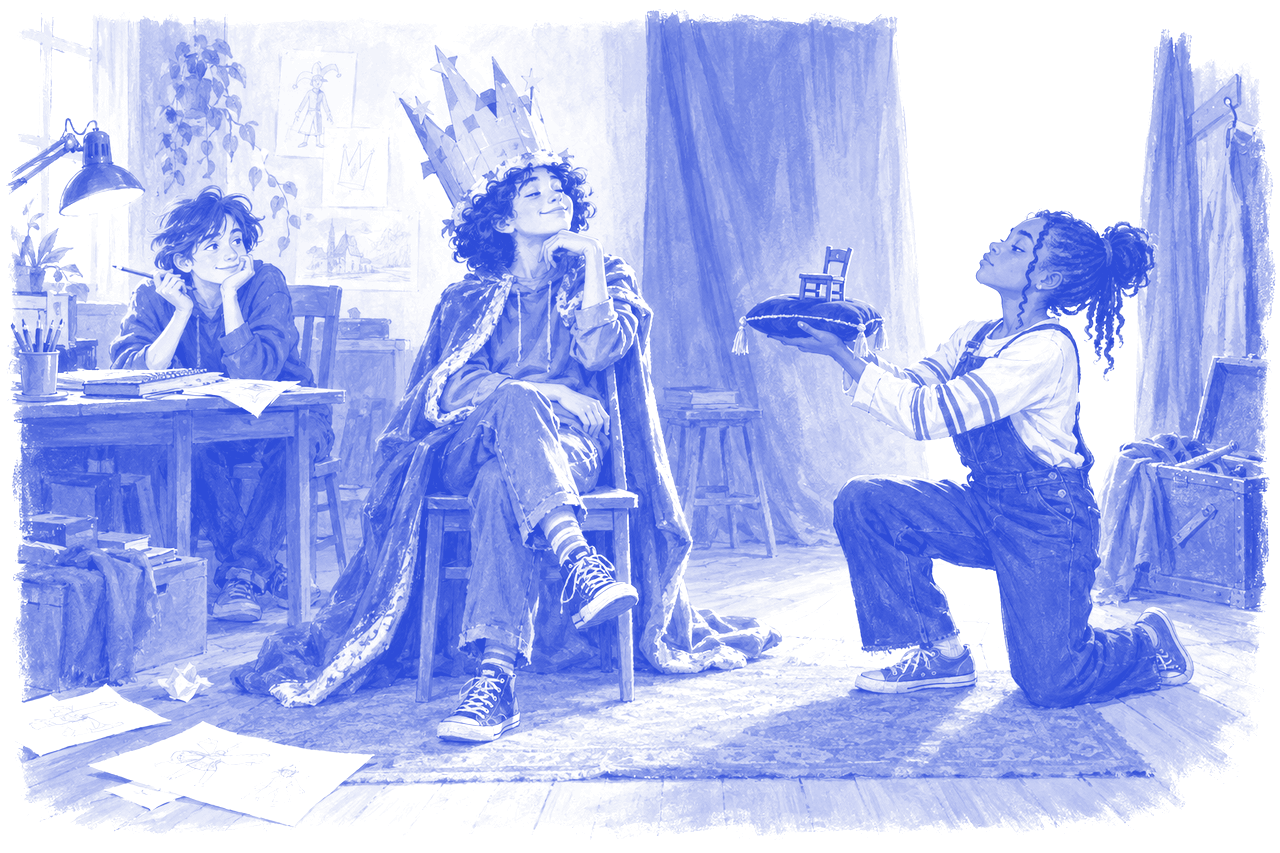
Three friends rehearse a play. The king lounges in a paper crown while an adviser kneels to offer him a tiny throne on a cushion.
By the third entrance, the throne fits on a cushion.

Before we begin

Who this book is for

You might , , , , , or simply like of an ordinary day.

If you write jokes, start here

2

Where Did You Think This Was Going? p. 9

A potato, a to-do list and a library that lends silence. Find out where a turn actually lives.

13

Your Comedy Workbench p. 61

Take one observation from your notebook to a finished version, then test it on a real reader.

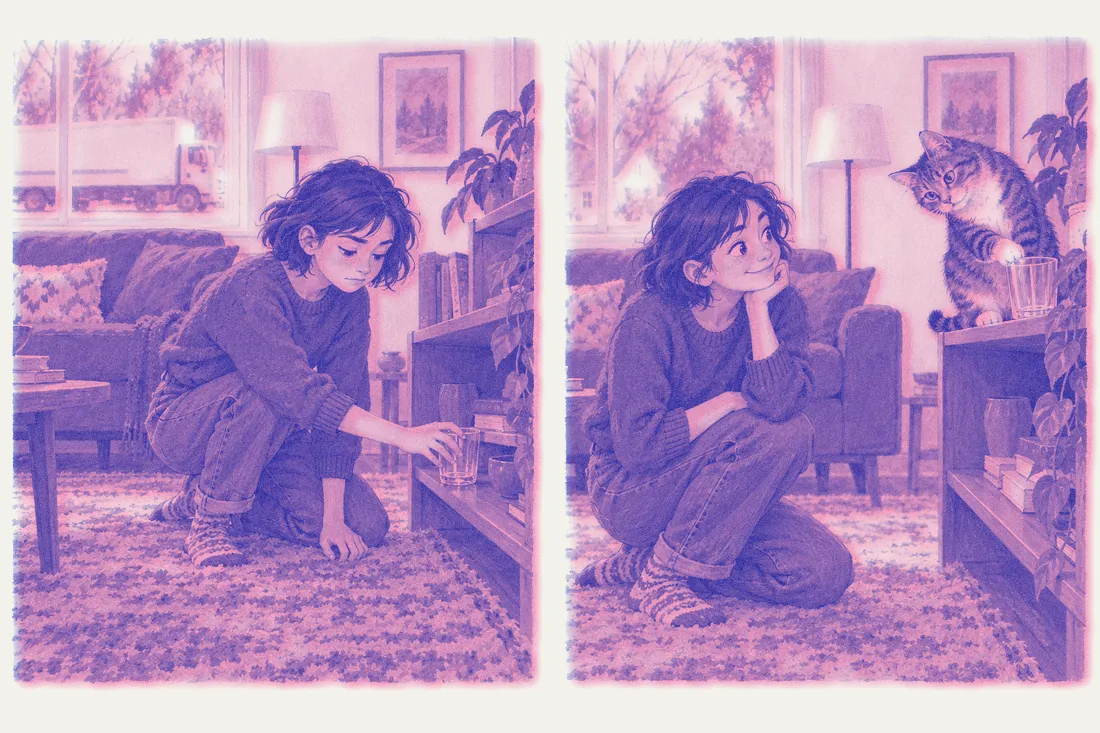
Two panels. A girl kneels to pick up a glass from the rug. Then a cat on the shelf above looks straight at her, one paw near another glass.
“You wouldn’t.” The paw continues.

You might also be the person with six ideas arriving at once and absolutely no filing system.

Chapter 1

Chapter 2 · Try it

Where did you think this was going?

At dinner, I asked my brother to take something off my plate.

After one sentence, what are you picturing?

He ate my last potato.

Pick one. There’s no wrong answer.

He has technically helped. You are still doing the dishes.

Food now arrives before the ambiguous phrase.

sentence 1 chores? homework? dinner? potato look back

More routes in Chapter 2 · page 9

Chapter 9 · More Than One Way to Be Funny

Let’s open several drawers.

A comedy toolbox can contain a potato, a very serious pause, a fake advertisement, an argument with a hat, and an old joke everyone knows is coming.

Anti-joke

A: “Knock, knock.”

B: “Who’s there?”

A: “Jo.”

B: “Jo who?”

A: “Jo from math. I need my calculator back.”

NoticeThe familiar knock-knock pattern invites you to expect wordplay with the name.

Eight drawers in Chapter 9 · page 41

Chapter 8 · Give It a Moment

Same words. Different pause.

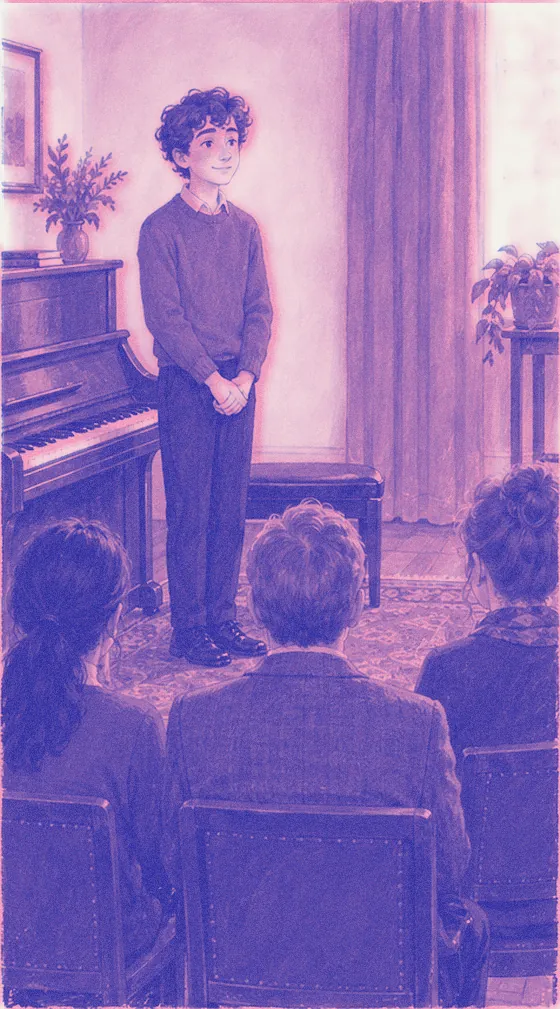
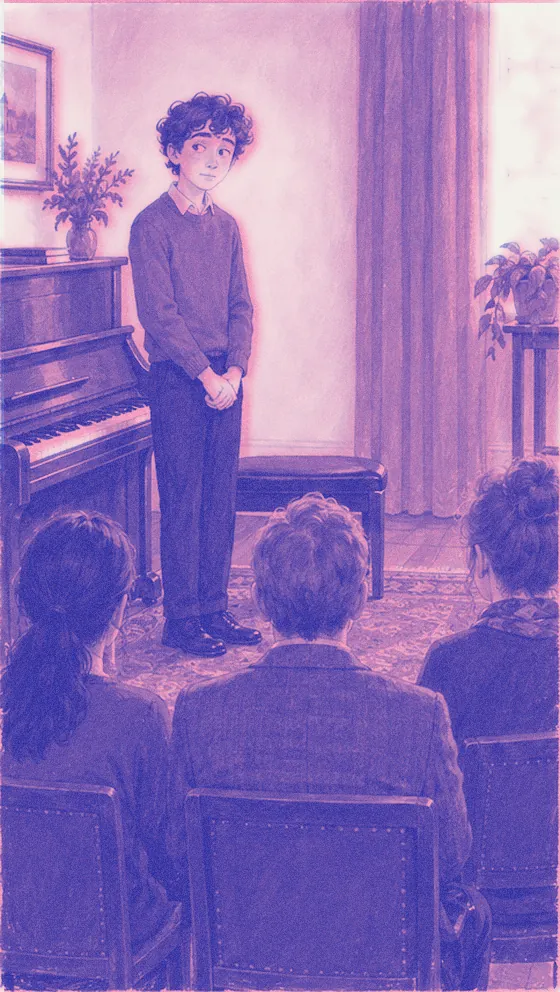
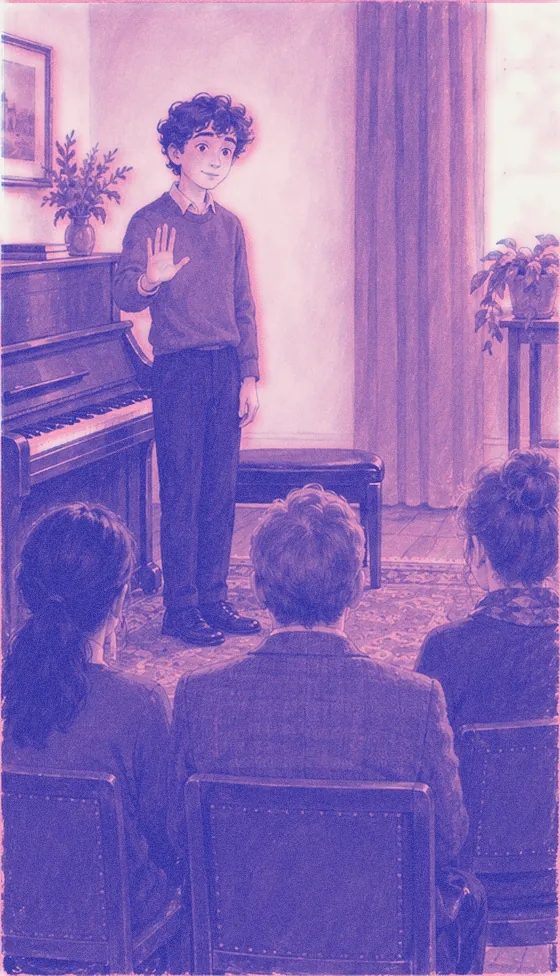
An amateur pianist stands beside the piano in a quiet room. Set the pause, then play the scene.

A young pianist stands beside a piano, facing a seated audience.

“I’ll begin when everyone’s quiet.”

He waits. The audience sits still.

He waits.

He raises a hand to quiet an audience that is already quiet.

“Take your time.” He raises a hand to quiet them.

1.5sa long pause

The words have not changed. The time available to notice their relation has.

Three endings to try in Chapter 8 · page 37

Chapter 3 · The Things We Care About

The smallest museum in town.

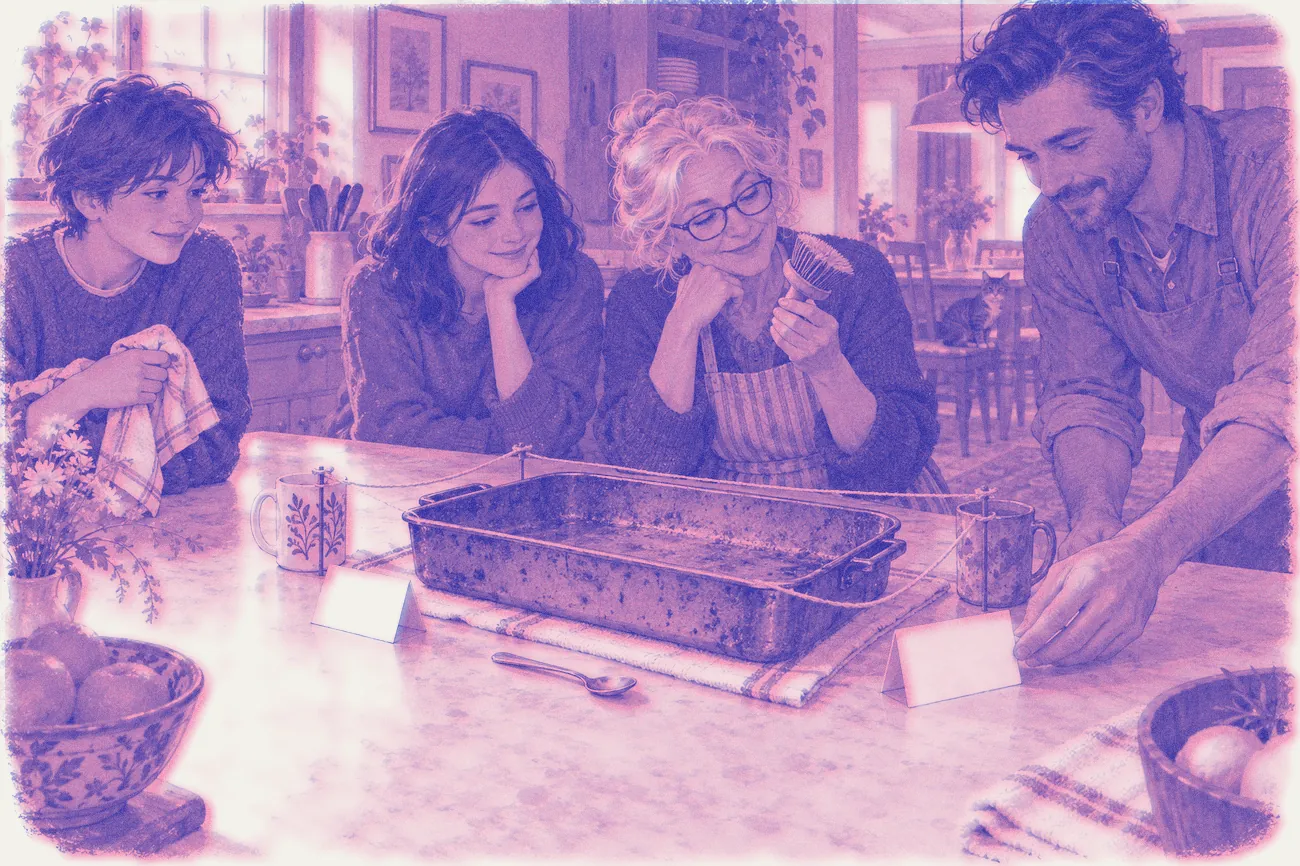
Dad labels the kitchen. The dishwasher breaks. One enormous roasting pan does not get washed. Step through the week.

A family leans over a kitchen counter. A dirty roasting pan sits behind a string stretched between two mugs, with little cards in front of it. Grandma examines a brush through her glasses while Dad adjusts a card.

Saturday

On Saturday, Dad announced that he had made the kitchen self-explanatory.

The first drawer said FORKS AND SPOONS. The next said OTHER TOOLS. A third said EMERGENCY TOOLS.

“What’s the emergency?” I asked.

“You open the second drawer and the thing you need isn’t there.”

Grandma has the brush. What does Dad do next?

The full scene · Chapter 3, page 14

Chapter 11 · Friendly Fire

It worked last time.

A joke can be well intended, get a real laugh, and reach somewhere the teller did not notice.

After school

Choosing where to eat after school takes Louisa so long that Martin has started bringing a snack for the decision.

Martin

You don’t miss deadlines. You give them a head start.

Louisa

You sent a calendar invite for fries.

Martin

People need notice.

Robotics club · a week later

The club is choosing jobs for a new project. The teacher leading the club has not worked with Louisa before. Louisa volunteers to keep track of the schedule.

Martin

You don’t miss deadlines. You give them a head start.same words. new listener.

Several people laugh. The teacher smiles.

Teacher

Maybe we’ll give someone else the reminders, then.

By the door · later

Louisa

Keep that one out of club, okay?

Martin

It was a joke.

Louisa

I know. Now he thinks I’m the one who makes everybody late.what should Martin do?

To be continued

Everyone laughed. So it worked… right?

Chapter 11 follows what Martin does next, and what a room’s laughter can and can’t tell you.

  • Why the same line lands differently with a new listener
  • Who was laughing at what, and schadenfreude
  • A laugh that is really someone trying to regain their footing
  • What to say if you’re the one caught

Chapter 11 · page 50

Chapter 13 · Your Comedy Workbench

A pencil, a page, and a little curiosity.

The book is full of invitations: small things to try with your own material. Here are a few.

Two friends at a table covered in hand-drawn comic panels. One draws; the other holds up a tiny paper chair. A paper crown and a cookie sit nearby.
A few ordinary objects. Several possible scenes.
Homework plannerCongratulations. We’ve found your biggest distraction.
YouWhat is it?
Homework plannerYou’re using it.

Invitation · Chapter 6 · p. 32

Choose an ordinary object: a hat, a trophy, a reminder note, a tiny bell. Give it a clear first use in a short scene. Later, let a new event make another use available.

1 of 8

Your Comedy Workbench · Chapter 13, page 61

What’s inside

There is a cookie waiting in chapter 1.

Set list

  1. 1A Cookie with a Job5
  2. 2Where Did You Think This Was Going?9
  3. 3The Things We Care About14
  4. 4Inside the Story20
  5. 5Who Is Doing the Funny Thing?24
  6. 6A Small Thing Comes Back29
  7. 7Make the Trip Worth Taking33
  8. 8Give It a Moment37
  9. 9More Than One Way to Be Funny41
  10. 10When a Line Doesn’t Land46
  11. 11Friendly Fire50
  12. 12The Name Behind the Picture55
  13. 13Your Comedy Workbench61
  14. 14Keep Noticing66
  15. +Words You Can Come Back To70

Words you can come back to

  • Answerability
  • Callback
  • CIRT
  • Compression
  • Destination payoff
  • Disturbance
  • Finesse
  • Frame
  • Friendly fire
  • Held value
  • Humility
  • Insulation
  • Invariant Relation
  • Journey payoff
  • Leverage
  • Nesting
  • Orientation
  • Participation
  • Persona
  • Recoverability
  • Retrospective reach
  • Scope
  • Settling
  • Trust

Twenty-four terms, each defined in the back with the chapters where it shows up.

For teachers and parents

Written for middle school and early high school readers: fourteen short chapters built on invented scenes, with invitations to try and a glossary.

The scenes are fictional teaching examples. CIRT (Comedic Invariant Relation Theory) is presented as a proposed framework whose explanatory claims remain open to investigation. Adult readers can find the full account in The Electric Room: Two-Book Collection.

There are other things on the table.

The Electric Room, Student Edition. How Comedy Works and How to Make It Your Own. By mFLO 111.

Get the book [BUY LINK]
Get the book